

Steps Three and Four- Identify Activities and Uses for the Landscape
go.ncsu.edu/readext?811956
en Español / em Português
El inglés es el idioma de control de esta página. En la medida en que haya algún conflicto entre la traducción al inglés y la traducción, el inglés prevalece.
Al hacer clic en el enlace de traducción se activa un servicio de traducción gratuito para convertir la página al español. Al igual que con cualquier traducción por Internet, la conversión no es sensible al contexto y puede que no traduzca el texto en su significado original. NC State Extension no garantiza la exactitud del texto traducido. Por favor, tenga en cuenta que algunas aplicaciones y/o servicios pueden no funcionar como se espera cuando se traducen.
Português
Inglês é o idioma de controle desta página. Na medida que haja algum conflito entre o texto original em Inglês e a tradução, o Inglês prevalece.
Ao clicar no link de tradução, um serviço gratuito de tradução será ativado para converter a página para o Português. Como em qualquer tradução pela internet, a conversão não é sensivel ao contexto e pode não ocorrer a tradução para o significado orginal. O serviço de Extensão da Carolina do Norte (NC State Extension) não garante a exatidão do texto traduzido. Por favor, observe que algumas funções ou serviços podem não funcionar como esperado após a tradução.
English
English is the controlling language of this page. To the extent there is any conflict between the English text and the translation, English controls.
Clicking on the translation link activates a free translation service to convert the page to Spanish. As with any Internet translation, the conversion is not context-sensitive and may not translate the text to its original meaning. NC State Extension does not guarantee the accuracy of the translated text. Please note that some applications and/or services may not function as expected when translated.
Collapse ▲Human Needs
A wildlife landscape must also be aesthetically pleasing, enjoyable, and functional for the people using it. They must enjoy and appreciate the landscape to be willing to invest in designing and maintaining it. Complete the Checklist of Possible Landscape Activities and Uses to identify their needs.
Locate and develop use areas. Consider the public use areas, including the entrance area, front yard, front walk, parking, lighting, foundation, and focal point. Also, consider the family activity areas, the utility and service areas, and the side yard.
Create a bubble diagram like the one below of the family’s use of garden space.

Family Use of Garden Space Design by Pat Lindsey
Wildlife Needs
Basic Needs
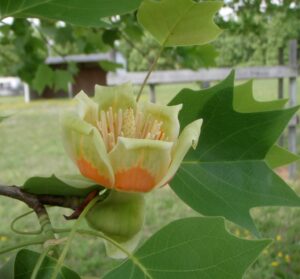
Yellow poplar (Liriodendron tulipifera) flowers and seeds are eaten by birds and other wildlife. Image by Jim Robbins, CC BY-NC-ND 4.0
All wildlife needs food, water, and cover.
- Food — Wildlife eat insects and spiders, acorns and other nuts, seeds, fruits, and nectar. Choices vary by type of wildlife, life stage, and season.
-

Blackberry (Rubus allegheniensis) bushes provide excellent year-round cover for birds and edible fruit. Image by Glenn Marsch, CC BY-NC-ND, Flickr
Cover – Animals require cover for nesting, resting, hiding from predators, and avoiding harsh weather.
- Water – Wildlife requires water year-round and obtains it from a variety of natural and man-made sources.
Limiting Factor – The least available component is termed the “limiting factor” and determines the number of animals that can occur in an area. For example, cover may be the limiting factor for songbirds in a backyard containing numerous feeders and a birdbath but no areas of dense vegetation for nesting or hiding from predators. Identify the limiting factor in your landscape and find a way to compensate for it before addressing other habitat components. This could mean adding plants that provide cover or including a birdbath in your design.
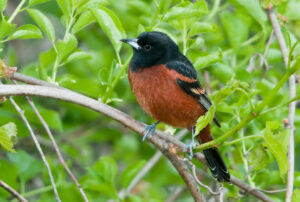
The orchard oriole is a neotropical migrant that spends winters in the tropics. Image by Kelly Colgan Azar-CC B-SA-Flickr
Seasonality—Birds and other wildlife’s habitat needs change with the seasons. From early April to mid-May, buntings, cuckoos, flycatchers, orioles, tanagers, thrushes, vireos, and warblers migrate north from Latin America to their breeding grounds in the United States. After nesting, these neotropical migrants fly south in September and October to avoid food shortages and dropping temperatures. Migrating birds favor dense vegetation, which protects them from predators.
Birds that live in North Carolina year-round, like bluebirds, northern cardinals, and chickadees, spend the winter here with other species that migrate southward into the state from breeding areas to the north. During cold nights and winter storms, these birds and other wildlife reside in evergreen vegetation, including hollies, wax myrtle, eastern redcedar, or pines. Include a variety of native plant species in your landscape to ensure that food and cover will be available throughout the year.
Specific Needs
Careful planning is required to meet the specific habitat requirements of each desired wildlife species. Use this form to document the specific needs of each wildlife species you want to attract.
Songbirds
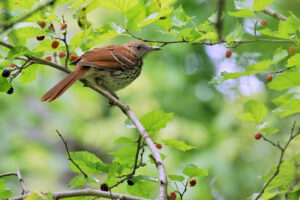
Brown thrashers eat fruits in the late summer, fall, and winter.- Image by Vicki DeLoach-CC BY-NC-ND-Flickr
Food – In the spring, migrating birds feed on insects found on the leaves of oak, black cherry, yellow poplar, black willow, and other deciduous trees. Later in the year, adult birds feed their nestlings insects and spiders that provide the protein and calcium important to bone and tissue growth. Some birds, including thrashers and thrushes, seek out fruits in the late summer and fall. Sparrows, juncos, and many other birds present in the winter eat seeds.
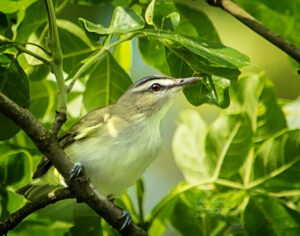
The red-eyed vireo nests in the tree canopy. Image by Stan Lupo, CC BY-NC-ND Flickr
Cover — Songbirds feed, nest, and rest in different types of vegetation. Because they can fly, birds can segregate themselves vertically within a landscape. Low-growing plants beneath the tree canopy provides vertical vegetation, allowing shrub-dwelling birds like northern cardinals to live directly below treetop birds like red-eyed vireo.
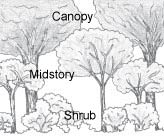
Landscape layers
Hummingbirds
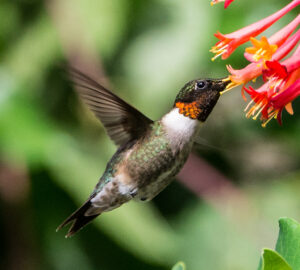
Ruby-throated hummingbirds drink nectar from coral honeysuckle (Lonicera sempervirens). Image by Pauline Horn CC BY-NC-ND Flickr
Food — Hummingbirds’ habitat requirements differ from those of other birds. Ruby-throated hummingbirds, the only species that breeds in North Carolina, feed on small insects and nectar from bright, tubular flowers.
Cover –Ruby-throated hummingbirds prefer areas of dense undergrowth and vine tangles for feeding and cover. They commonly occur in gardens and along woodland edges.
Butterflies
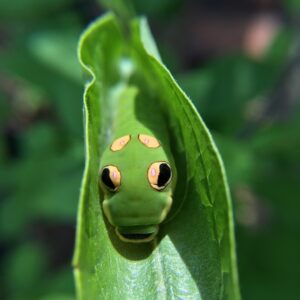
Spicebush (Lindera benzoin) is a host plant for the Spicebush Swallowtail caterpillar and also produces fruits eaten by birds Image by Allison Pittman CC-BY-NC 4.0
The beautiful natural landscape of the southeastern United States provides a home for hundreds of butterfly species. More than 160 butterfly species occur in North Carolina. Some species are found statewide, while others are restricted to a specific habitat or region.
Food – The types of plants (and parts of plants) that butterflies eat as caterpillars vary widely from what they eat as adults. A typical butterfly’s life begins as an egg laid on the leaf of a host plant. When it hatches, it feeds on the leaves of the host plant. Each species of butterfly caterpillar has unique food requirements that restrict it to specific host plants. For example, the spicebush swallowtail uses the spicebush as its host plant. Adult butterflies feed on nectar from a variety of flowers.
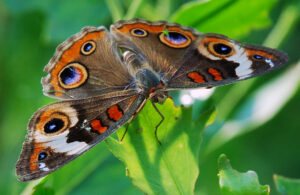
The common buckeye is often seen in urban gardens. Image by pahrkm, CC BY-NC Flickr
Cover – Butterflies use plant foliage, downed wood, and standing dead trees as cover throughout the year. During hot afternoons on summer days, butterflies may seek out shady areas. Many butterfly caterpillars are camouflaged to resemble leaves or bird droppings so that they blend in with the foliage of their host plant. Some butterfly adults hide in tree cavities or other tight spots during the winter.
Reptiles and Amphibians
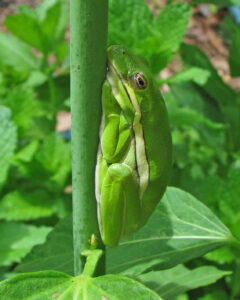
This Green Treefrog is well camouflaged as it rests on a green stem. Image by Vicki DeLoach CC BY-NC-ND Flickr
Food — Many tadpoles eat mostly plants and aquatic larvae (like mosquito larvae). Typically, adult amphibians eat insects and other small invertebrates. Some larger species eat small vertebrates, including fish, other amphibians, and small birds.
Cover — Amphibians need access to pools, ponds, streams, seeps with surface water, or marshes to lay eggs and, for some, to live as adults. They also need access to dry land for adult life, breeding, and movement between aquatic environments. Many rely on damp, rotting logs and stump holes to protect them from predators and weather and to keep their skin moist.
Keep Records for a Year
Before beginning habitat improvements, observe the changes in your landscape throughout the seasons.
Photograph Your Landscape – Take pictures of different areas of your yard during different seasons. As you develop a final plan, these photos will help you remember how the yard looked at various times of the year.
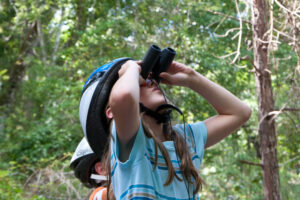
Use binoculars to make observations of wildlife. Image by Florida Fish and Wildlife-CC BY-NC-ND Flickr
Make Wildlife Observations – Keep records of the wildlife using your landscape, making sure to note what areas are used and the specific timing of that use. Animals are predictable and will appear in your landscape at the same time each day and season each year. Use binoculars to identify the animals in your yard and record detailed information about your observations. Use this record to identify which areas of the landscape are performing well and which areas need habitat improvement. These records can also guide your management choices, such as when to clean out nest boxes, where to erect feeders, and when to prune plants.
Investigate Wildlife Habitat Value – Observe how wildlife uses the existing native plants. Retain as much existing native vegetation as possible as you begin creating your native plant landscape.
Create a bubble diagram like the one below of wildlife landscape use.

Wildlife Landscape Use. Design by Patricia Lindsay
The following weblinks and field guides can help you identify the wildlife in your landscape:
Birds
- Cornell Lab of Ornithology
- Patuxent Wildlife Research Center
- Birds of the Carolinas. By Eloise Potter, James Parnell, and Robert Teulings. The University of North Carolina Press.
- The Sibley Field Guide to Birds of Eastern North America. By David Allen Sibley. Alfred A. Knopf, Inc.
- Field Guide to Birds of North America. National Geographic Society.
- Eastern Birds. By Roger Tory Peterson. Peterson Field Guide Series.
- The Birder’s Handbook: A Field Guide to the Natural History of North American Birds. By Paul Ehrlich, David S. Dobkin, and Darryl Wheye. Simon and Schuster, Inc.
Butterflies
- Butterflies and Moths of North America
- Jeff’s Butterfly Page
- Eastern Butterflies. By Paul Opler and Vichai Malikul. Peterson Field Guide Series.
- Butterflies through Binoculars: The East. By Jeffrey Glassberg. Oxford University Press.
Caterpillars
- Caterpillars of Eastern Forests. By David L. Wagner, Valerie Giles, Richard C. Reardon, and Michael L. McManus. United States Department of Agriculture
- Caterpillars in the Field and Garden: A Field Guide to the Butterfly Caterpillars of North America, Oxford University Press.