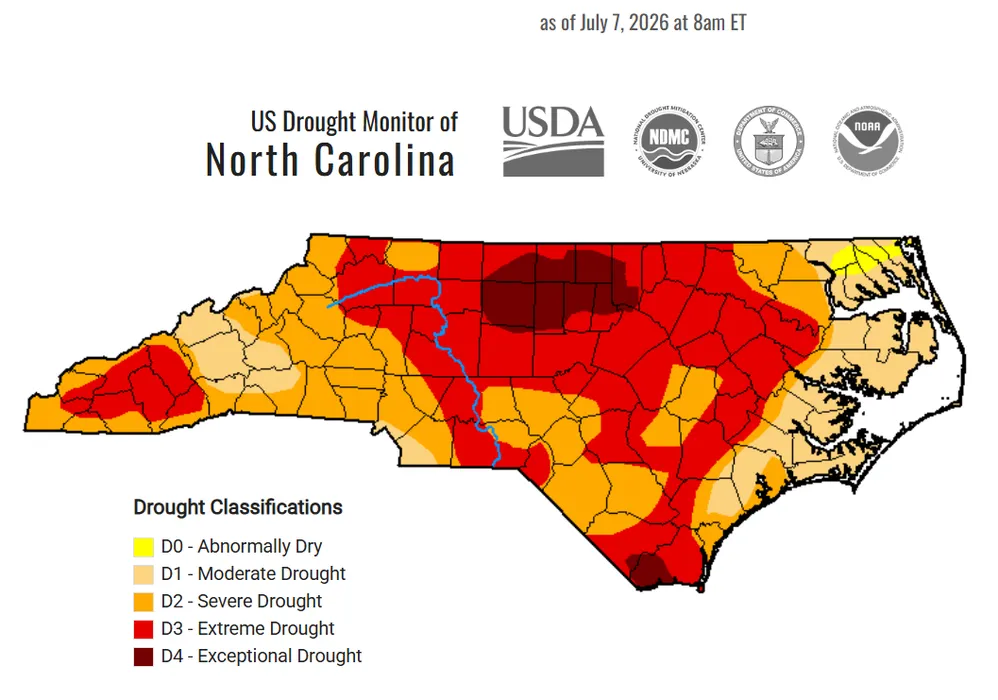
NC State Drought Map, Updated July 7, 2026, North Carolina Drought Management Advisory Council
SIGNS OF DROUGHT STRESS
Primary signs of drought stress
- Leaves and Needles
- Wilted leaves that do not return to normal by morning. Plants with large leaves are the first to wilt in the heat of the day.
- Upward curling or rolling of leaves
- Abnormal yellow, brown or blue/gray leaf margins, tips, or entire leaf.
- Yellowing between veins
- Smaller than normal leaves
- Brown needles inside the canopy of evergreens
- Leaf scorch
- Leaf drop
- Shoots and Stems
- Less than normal shoot growth
- Flowers and Fruits
- Blossom and fruit drop
- Under-sized and off-flavored fruits, nuts, and vegetables
Secondary signs of drought stress
- Spider mites
- Increased animal and insect damage due to a lack of food and water
Potential long-term consequences of drought
- Dieback in the canopy and roots
- Increased susceptibility to plant diseases and insect borers
- Root death
- Diminished winter hardiness
- Eventual plant death
DURING THE DROUGHT:
Don’t encourage growth
- No new plants, no fertilizing, no pruning, except to remove dead or dying branches. New, succulent growth is most vulnerable.
Restrict traffic over the lawn and the root zone of trees and shrubs
Manage mulch
- Ensure all vegetable, flower, and landscape beds have a 2 inch layer of mulch to conserve water, keep soil temperatures cooler, and prevent weeds from competing with desired plants. Consider mulching in a doughnut shape around trees and shrubs from the trunk to the dripline to prevent competition from turf, weeds, and other plants. Keep mulch 6 inches from the base of the trunk. NOTE: If the mulch is too deep, roots grow up into the mulch and are more vulnerable to drought damage.
Remove weeds
- Prevent them from competing with plants for moisture.
Remove plants
- that are past their prime, stressed by disease or insects, or that you are planning on replacing in the future.
If you water
- Reduce the amount of water used in your landscape by 20 - 40 percent or more by gradually (over a few weeks if possible) decreasing the amount of water applied to lawns, trees, and plants.
- Identify priority plants (mature trees & shrubs, valuable and sentimental plants)
- Apply water directly to the ground early in the morning.
- Water deeply and infrequently to promote deep roots and drought tolerance.
- Water slowl to prevent runoff.
- Consider installing an irrigation system, using soaker hoses, placing slow-release watering bags, drilling small holes in multiple five-gallon buckets or milk jugs and filling them with water.
- Water the entire root zone of the plant which extends 2-3 times the distance from the trunk to the dripline.
- Many plants wilt in the middle of the day, unable to take up water as quickly as they lose it through transpiration. This can happen even when the soil is wet. They are only drought-stressed if they do not recover by morning.
- Allow the soil to dry between before watering to promote root development deeper in the soil and more resilient to drought. Allowing the plant to experience occasional mild drought stress increases drought tolerance
- Do Not Overwater - check the soil before watering, there are many other possible causes for drought-like symptoms.
Harvest Rainwater
- Install cisterns or rain barrels to capture rain water for later use in the landscape.
- Build rain gardens.
- Contour the land to create effective berms and swales to slow storm water runoff.
Allow your lawn to go dormant
- Taper off irrigation by waiting for symptoms to appear before watering. (footprints remain for several minutes, blades turn blue-grey).
- Increase mowing height to 3 inches.
- Stay off the grass as crowns are easily damaged in drought.
- Tall fescue, bermudagrass, and zoysiagrass are tolerant of drought if allowed to go dormant.
- Yellow, brown, and withered leaves are normal signs of dormancy
- Most turfgrasses can withstand 3 to 6 weeks (or longer) without rainwater or irrigation with minimal or no damage.
- Provide only 0.25 inch of water every three weeks to keep the growing points hydrated.
- Remove turf under the canopy of trees and replace it with 2 inches of mulch
AFTER THE DROUGHT
- Take Notes: Record what dies, what survives, what steps were effective, and what didn’t work.
- Remove dead wood.
- In the fall, consider replacing plants that died with ones both well adapted to your site and drought tolerant. Use the Extension Gardener Plant Toolbox to select drought-tolerant plants. Since we also have flooding, consider plants that are tolerant of both.
- Annuals: Drought Tolerant, Tolerant of both Drought and Wet Soils
- Perennials: Drought-Tolerant, Tolerant of both Drought and Wet Soils
- Shrubs: Drought-Tolerant, Tolerant of both Drought and Wet Soils
- Trees: Drought-Tolerant, Tolerant of both Drought and Wet Soils
- Lawns: Drought-Tolerant
- Narrow the list by selectingAA the amount of sun light, space, and climate in your yard. Explore plants that are resistant to other challenges using the option in the left column, individually and in combination.
- Continue to water through the winter as roots continue to grow, even when the plant is dormant.
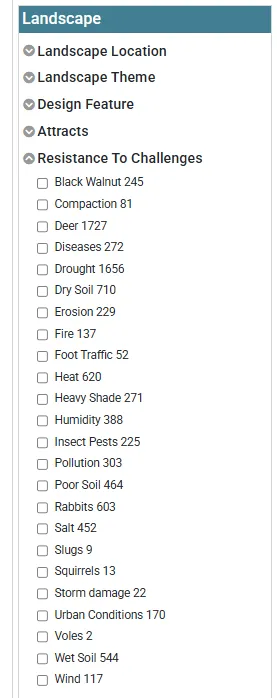
"Resistance to Challenges" section of the Extension Gardener Plant Toolbox
BEFORE THE NEXT DROUGHT
- Plan for the next drought. Learn to conserve water both inside and out.
- Modify your landscape to increase resilience to drought conditions. Water Use It Wisely
- Consider transplanting plants into groups with similar water needs so none are over or under watered to meet the needs of their neighbor.
- Build topsoil by keeping the ground covered with 2 inches of mulch and replacing as it breaks down.
- Minimize plant stress through best management practices for plant selection, installation, irrigation, fertilization, pest management and pruning. Healthy plants are more resilient.
- Install or check and repair existing irrigation
- Dethatch and core/aerate the lawn when it is actively growing
- Slowly ease the landscape into dormancy
- Allow drought stress symptoms to appear between infrequent irrigations
- Mow lawns high
- Do not over-fertilize with nitrogen.
U.S. Department of Agriculture People’s Garden Initiative
Fruits and Vegetables
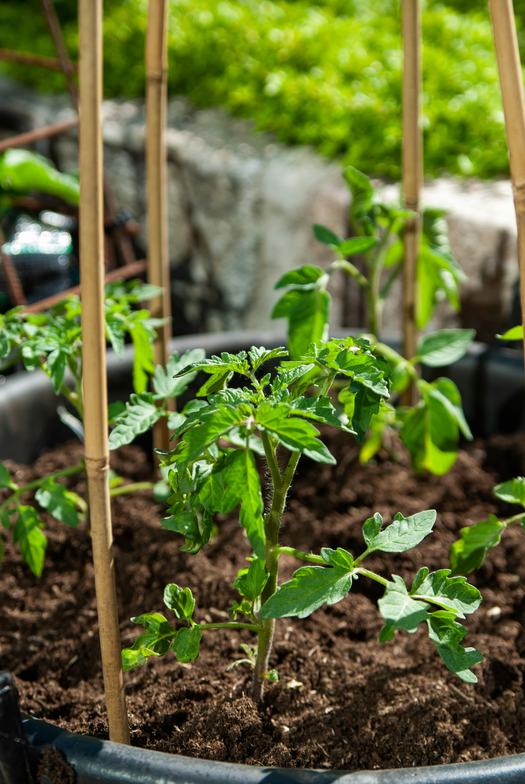
- Consider water restrictions before starting a vegetable garden. Keep the garden just large enough to meet your needs.
- Select crops that mature quickly and are drought-resistant.
- Incorporate compost into the soil to improve water permeability and retention. Ensure compost does not make up more that 20% of the soil volume.
- Supplement rainfall to ensure plants receive 1″ of water per week. Use a water-efficient drip irrigation system to ensure water is applied directly where needed and slowly enough to soak in.
- Take special care to avoid drought stress during germination, transplanting and fruit development.
- Fruit and nut trees need adequate water from bloom until harvest for good fruit production.
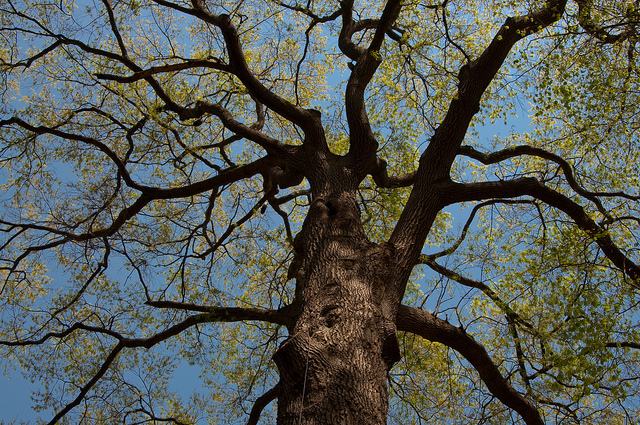
Image by Leo Suarez
Ornamental Plants
- Reduce the amount of water used in your landscape by 20 - 40 percent or more by gradually (over a few weeks) decreasing the amount of water applied to lawns, trees, and plants.
- Identify priorities for watering ornamentals:
- Top Priority:
- Trees and shrubs planted within the last 2 years will be most vulnerable to drought stress since their root systems are not fully developed. The roots of newly installed plants may not yet have grown out into the surrounding soil and still be in the rooting media from their nursery pot. That mixture of media is selected to drain quickly so will dry out sooner than the surrounding soil. Water the rooting media near the trunk to to protect the roots.
- Established trees and shrubs are the biggest investment of time and money and have the greatest impact on the landscape and the house.
- Rare or unusual specimen plants that would be difficult or expensive to replace, and those with high sentimental value.
- Evergreens: Drought in the fall and winter is particularly dangerous to evergreens like rhododendrons, boxwood, pine, and spruce that lose water throughout the winter as cold winds pull moisture from their needles and leaves. Once the ground freezes, the plant cannot take up water through its roots until it thaws. If the plant is already drought-stressed, then needles and leaves may die. To prevent damage to evergreens, ensure they receive an inch of water per week.
- Medium Priority:
- Drought-sensitive plants like hydrangeas, Japanese maples, azaleas, and dogwoods are unlikely to survive an extended drought.
- Lowest Priority: (consider removing to conserve water for cherished plants)
- Plants you don’t like and plan to replace;
- Plants that are often stressed in your landscape;
- Annuals are the least expensive, easiest to replace, and will die at the end of the season even if watered.
- Plants in crowded beds.
- Continue to water through the winter as roots are growing, even when plants are dormant.
- Top Priority:
Design by Jay@MorphoLA
Lawn
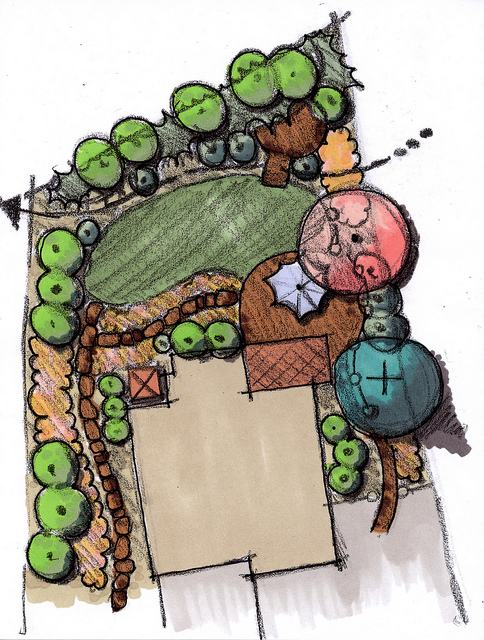
- Limit turf to play and entertainment spaces. Lawns often require the most water, fertilizer, pesticide, and maintenance in the landscape so use only where functional. Where turf is not essential, replace it with drought-tolerant ground covers, mulch, deck, or paths.
- Install drought-tolerant varieties adapted for your climate, for example, Bermudagrass, and Zoysiagrass.
- Adjust the watering schedule based on rainfall, heat, and day length.
- Water in the early morning to minimize evaporation while also limiting disease potential.
- Set the mower to the highest recommended cutting height for your turf variety to slow growth, promote deep roots, protect from sunburn, shade soil, and reduce weeds.
- Allow your lawn to go dormant. It is much less stressful for the turf to remain dormant than it is to be repeatedly watered and then drought-stressed.
Don’t let one year’s dry weather convince you to create a desert landscape. We also have very rainy weather. Create a landscape using resilient plants that tolerate both wet and dry conditions.
Use of Bath Water and Other Gray Water on Plants
By North Carolina law, bathwater, dishwater, washing machine water, and all other household water (except water from toilets), known as gray water, is sewage, and legally can only be disposed of through a proper system. If you intend to use grey water, make sure you understand the safety ramifications. Never use gray water on anything that may be eaten and do not spray gray water, or allow it to puddle or run off your property. Do not use water that has come in contact with soiled diapers, meat, poultry, or anyone with an infectious disease. Never use toilet water, also known as black water which must go to a treatment facility.
Thanks to Charlotte Glen and the University of California for the information used in this post.
***